Zero Cash Fee, 10,000+ Videos: The Product Barter System That Scaled Creator Content at Volume
 By Hasbiarahman Efendi · 26 June 2026 · 9 min read
The most underrated tool in affiliate marketing isn't a bigger budget. It's product.
Most brands think creator partnerships require cash. A fee per post. A negotiated rate. A line item in the marketing budget that scales linearly — more content means more spend.
Over a six-month period, we proved a different model entirely.
Using pure product barter — no cash fees, no commission top-ups, just product in exchange for content — we generated 10,000+ shoppable videos for a major global beauty brand.
No per-video fee. No paid partnership rates. Just a well-engineered barter system running on top of an engaged creator community.
Here's exactly how it worked — and why barter, done at scale, outperforms paid partnerships for a specific and important set of goals.
The Foundation: Barter Only Works If You Already Have a Community
This program would have been impossible without one thing: the 6,000-creator community we had already built.
That's the part most brands miss. They try to launch barter campaigns cold — sourcing creators, negotiating one by one, shipping product to strangers and hoping for content in return.
We had the opposite starting point.
We had a warm, engaged, opt-in base of 6,000 creators already organized into managed communities. When we had product to seed, we didn't need to go find creators.
We just had to announce it.
That single structural advantage is what made barter viable at volume.
The Mechanic: Simple by Design
The barter offer was deliberately simple and consistent:
- ✅ Creator receives 1–2 products (free)
- ✅ In exchange, creator commits to 3 shoppable videos
- ✅ Content terms agreed upfront — mutual consent, not unilateral demand
- ✅ Products were mostly new launches — positioned as exclusive early access for community creators
That last point was the strategic core of the entire program.
We weren't giving creators leftover inventory. We were giving them first access to products before the public — a privilege, not a handout.
Exclusivity changes the psychology of barter entirely.
Free product, framed as a giveaway, feels cheap. Free product, framed as exclusive early access reserved for your community, feels like status. Same product. Completely different creator motivation.
The End-to-End Flow
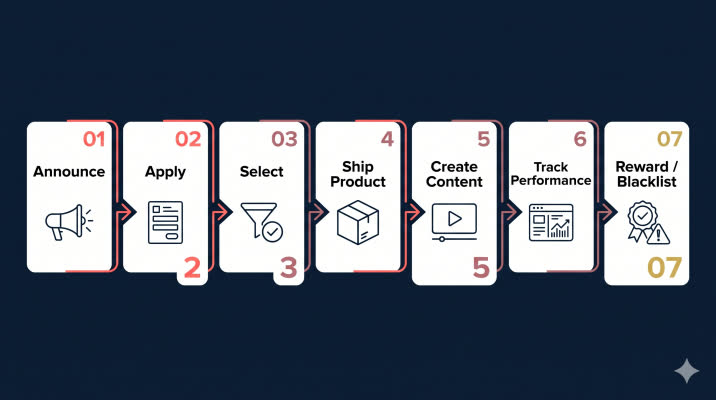
With the community in place, the operational flow was clean:
- Announce the barter opportunity inside the 6 communities
- Collect applications via a registration form
- Screen and select eligible creators
- Announce winners — the creators who qualified for product
- Ship product to selected creators
- Execute SOW — creators produce their 3 videos
- Track performance — monitor delivery and results
Simple on paper. Genuinely complex at scale. And that complexity is where the real work — and the real lessons — lived.
The Operational Reality: Four Bottlenecks We Had to Solve
Anyone can describe a clean process flow. The actual challenge of running 10,000+ video commitments through barter was managing what broke as volume increased.
1. Logistics & Fulfillment
Shipping physical product to a large, distributed pool of creators is a genuine supply chain operation — not a marketing afterthought.
Coordinating addresses, dispatch, tracking, and confirming receipt at this volume was one of the most resource-intensive parts of the program. Product that doesn't arrive is content that never gets made.
2. Data Infrastructure Strain
We ran the entire operation on spreadsheets — the same single-source-of-truth approach that powered our onboarding and GMV work.
But at this volume, the spreadsheet began to buckle. Tracking applications, selections, shipments, SOW status, and content delivery across thousands of records pushed our tooling to its limit.
This was a clear, honest lesson: the operational tool that scales you to one stage often becomes the bottleneck at the next. Knowing when you've outgrown your infrastructure is itself a management skill.
3. Applicant Screening
When you announce free exclusive product to 6,000 creators, you get a flood of applications.
Selecting the right creators — those with the right audience fit, content quality, and likelihood to deliver — became a meaningful filtering challenge. Selection discipline at the front end directly determined content quality and completion rates at the back end.
4. Sourcing Beyond the Community
For certain campaigns, we needed creators outside our existing base — which introduced a sharper strategic problem.
The Insight Most Brands Get Wrong About Barter
When we needed to expand beyond our community, we learned something that reshaped how I think about creator partnerships:
Large, established creators generally will not work for pure barter.
Their time has a clear cash value. A free product, however premium, doesn't compensate them for content they could otherwise charge for. So pursuing top-tier creators with a barter offer is largely a dead end.
Recommended by LinkedIn
 Meta's Hidden Trust Score HATES AI UGC... Chase Fisher 5 months ago
 How to Scale Your Ecom Brand to Multi 7-Figures Using… Chase Fisher 5 days ago
 How to Get 500+ UGC Videos for $1 Each (WITHOUT Using… Chase Fisher 5 months ago
The creators who do say yes to barter are emerging and early-stage creators — and that's not a limitation. It's the entire point.
For an emerging creator, barter is a genuinely good deal:
- They get free product they may not otherwise afford
- They get content for their portfolio at a growth stage where they need volume
- They get affiliate commission upside on every sale they drive
This means barter is fundamentally a long-tail strategy — a tool for activating a mass of emerging creators, not for landing a handful of big names.
And when we needed to grow that long tail, we deliberately targeted creators already working with competitor brands — bringing emerging talent into our ecosystem before competitors locked them in.
Barter, used correctly, is a customer acquisition tool for creators — not just a content tool.
Solving the Hardest Problem in Barter: Accountability
Here's the question every experienced marketer asks about barter:
If you give creators free product upfront, how do you ensure they actually deliver the content?
This is the single biggest risk in any barter program. Product goes out. Does content come back?
We solved it with a clear two-part system.
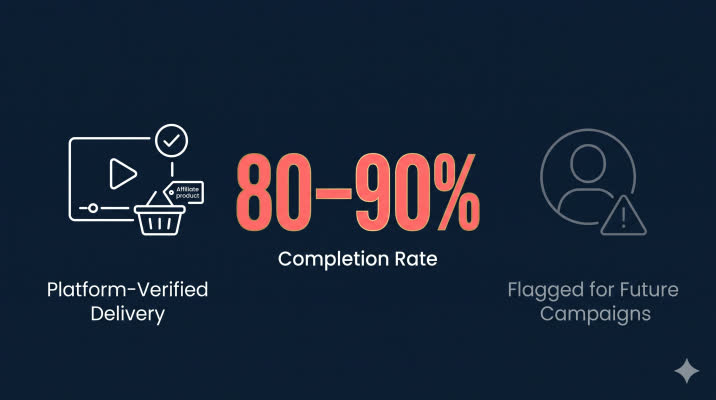
1. Delivery Tracking via Seller Dashboard We monitored content delivery directly through the seller dashboard, tracking the affiliate product tags (the yellow basket) on creator videos. This gave us a verifiable record of who had actually delivered against their SOW — not self-reported, but platform-confirmed.
2. A Blacklist for Non-Delivery Creators who received product but failed to deliver their committed content were flagged and blacklisted from future campaigns.
This created a real incentive structure. Access to future exclusive products — the very thing creators valued — was contingent on honoring current commitments.
The result of this accountability system speaks for itself:
An 80–90% completion rate across the program.
For a pure barter model — no cash retainer, no contractual penalty beyond exclusion — that completion rate is exceptional. It was earned through clear expectations, platform-verified tracking, and a consequence that creators genuinely cared about.
Why Barter Beat Paid Partnerships for This Goal
Barter isn't always the right tool. For brand campaigns requiring specific premium creators, paid partnerships win.
But for the goal we were solving — flooding the platform with authentic content volume to seed new launches and revive slow-moving products — barter was dramatically more efficient.
Here's the logic:
- New product launches need broad seeding and social proof. One expensive creator post can't manufacture that. Thousands of organic videos can.
- TikTok's algorithm rewards content velocity and breadth. A high volume of shoppable videos circulating simultaneously creates the kind of discovery surface area that paid placements simply can't replicate.
- Slow-moving products need momentum and visibility, not a single hero asset. Barter generates the sustained content drumbeat that builds it.
The economics are decisive. The cost of product is a fraction of the cost of equivalent paid content — and you convert marketing inventory into both content and GMV simultaneously.
10,000+ videos through paid partnerships would have required an enormous budget. Through barter, it required product, systems, and disciplined execution.
3 Principles for Running Product Barter at Scale
1. Barter is a community strategy before it's a content strategy. The reason our barter program scaled was the 6,000-creator base behind it. If you don't have an engaged community first, you're not running barter — you're running cold outreach with extra logistics. Build the community, then activate it with product.
2. Frame product as access, not as a giveaway. Exclusive early access to new launches makes free product feel like a privilege. The same product positioned as a handout attracts low-intent creators and low-quality content. Scarcity and exclusivity are what turn free product into genuine creator motivation.
3. Accountability is non-negotiable — and it has to have teeth. Barter without a delivery-tracking and consequence system is just giving product away and hoping. Platform-verified tracking plus a blacklist for non-delivery is what protected our completion rate. Make the thing creators want — future access — contingent on honoring current commitments.
Closing the Series: The Bigger Picture
Across this three-part series, one theme connects everything:
Scale in the creator economy is not a budget problem. It's a systems problem.
- Part 1: We onboarded 6,000 creators in under a month — by designing the operational architecture before recruiting a single creator.
- Part 2: We grew creator GMV contribution from 5% to 20% — not by recruiting more creators, but by building a better engagement system for the ones we had.
- Part 3: We generated 10,000+ shoppable videos with zero cash fees — by turning product into a precision instrument for content at volume.
None of these results came from a bigger budget.
They came from building systems that turn creators into a compounding, long-term brand asset — not a recurring line item to be switched on and off.
That, I believe, is the future of social commerce in beauty and FMCG. The brands that build these systems will own the next decade of creator-led growth.
The brands that keep treating creators as a transaction will keep paying more for less.
💬 For Affiliate, Partnership, and Brand leaders reading this:
Have you used product barter as a serious performance lever — or is it still sitting in your strategy as an afterthought? What stopped you from scaling it?
♻️ Repost if you know a brand or marketer rethinking how they work with creators. 🔔 This concludes my 3-part series on scaling affiliate creator ecosystems in Beauty/FMCG. Follow me for more data-driven frameworks on affiliate marketing, the creator economy, and social commerce growth.
#AffiliateMarketing #CreatorEconomy #SocialCommerce #InfluencerMarketing #BeautyMarketing #FMCG #ProductSeeding #GrowthMarketing #TikTokShop #PerformanceMarketing
First published on LinkedIn.