What 5 People and 6,000 Creators Taught Me About Building Teams
 By Hasbiarahman Efendi · 28 June 2026 · 8 min read
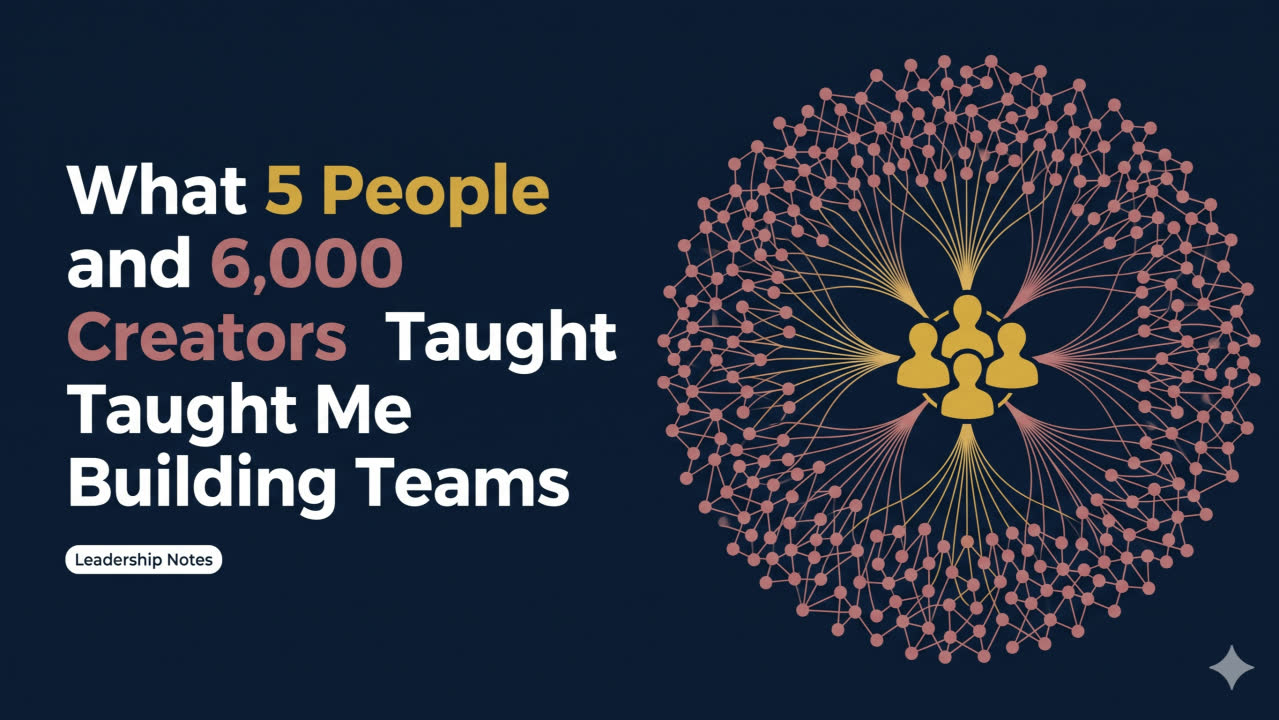
The hardest part of managing 6,000 creators wasn't the creators. It was learning how to lead the 5 people behind them.
Most of my LinkedIn writing has focused on systems, GMV, and operational scale.
But behind every number in those stories was a team of 5 — and this was the first team I had ever led.
No prior management experience. Five fresh graduates. And a mandate to build a creator ecosystem at a scale none of us had attempted before.
This is what that experience taught me about leadership — including the mistakes I'd correct if I could do it again.
The Setup: 5 People, One Massive Mandate
The structure was deliberately lean.
Each team member owned one community of ~1,000 creators. That alone was a significant responsibility.
But community management was only half their role. On top of it, each person owned a specialized operational function for the entire program:
- 🎯 Seeding PIC — managing product seeding operations
- 📦 Logistics Tracking — coordinating fulfillment at scale
- 📝 Content Strategy — shaping creator briefs and content direction
- ⚙️ CRM & Tools — owning our operational systems
- 📊 Data Analysis — turning performance data into decisions
So every person wore two hats: community manager + functional specialist.
It was demanding by design. And with a team this small, there was nowhere to hide a weak process — or a leadership mistake.
Lesson 1: Leading Fresh Graduates Means Building, Not Just Delegating
Here's something I underestimated going in.
My entire team was fresh out of university. Technically capable, but with limited business acumen.
In the beginning, they did exactly what they were told — no more, no less. They executed instructions. But they didn't yet connect why the work mattered to what the business was trying to achieve.
That was my job to change.
The shift didn't happen through a motivational speech. It happened through consistent context.
Every task came with the reasoning behind it. Every target came with an explanation of what would happen if we missed it — and what it meant if we hit it.
Over time, something changed.
The team stopped executing orders and started sharing my objectives. They began thinking about outcomes, not just tasks. They started spotting problems before I did.
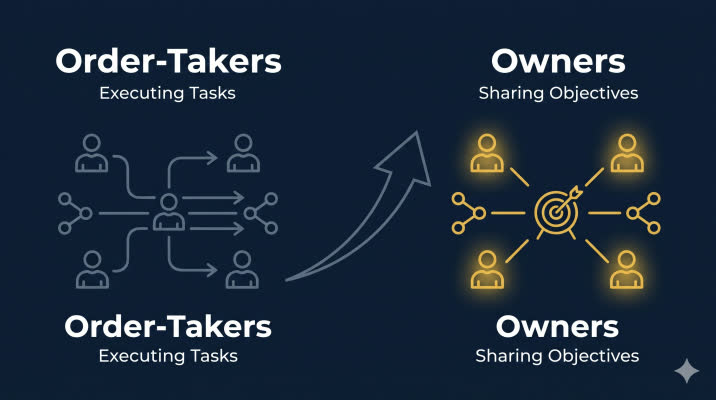
That transition — from order-takers to owners — is the most rewarding thing I experienced as a leader.
And it taught me that with junior talent, your job isn't to extract output. It's to build business thinking that compounds long after the current project ends.
Lesson 2: Start Hands-On. Earn Your Way to Hands-Off.
People love to debate hands-on vs. hands-off leadership as if you have to pick one.
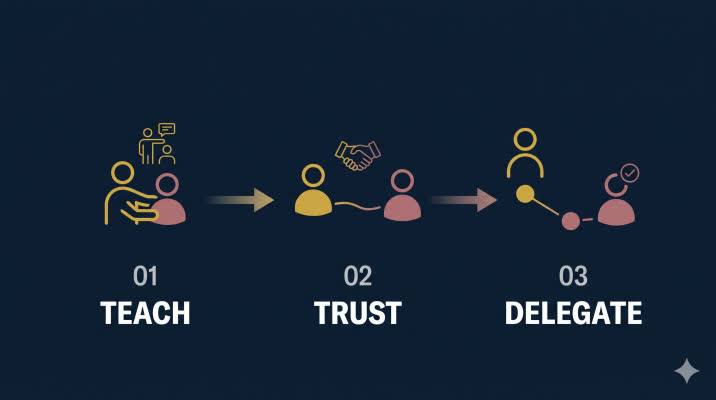
My experience taught me it's not a choice. It's a sequence.
In the early days, I was deeply hands-on. I sat with each person and taught the work directly — how to manage their community, how to run their function, how the tools worked.
I didn't delegate blindly. I demonstrated first.
Only once I genuinely trusted someone's judgment on a task did I step back and let them run it independently.
This is also how my leadership style evolved into what it became by the end: I proposed the ideas, the team designed and executed, and I served as the approver.
But that model only worked because of the hands-on foundation I built first. You cannot delegate to people you haven't developed.
Trust isn't given on day one. It's built, task by task, until handing off the work feels safe — for both of you.
Lesson 3: A Small Team Has No Redundancy — And That's a Real Risk
This was one of the hardest operational realities of leading a team of 5.
When each person owns a critical, specialized function, there is no backup.
When one PIC fell sick, the work didn't pause. I had to step in and cover it myself — because finding someone who could absorb a specialized function on short notice was nearly impossible at our size.
The skill gaps between team members made cross-coverage even harder. Each person had gone deep in their own domain, which made them valuable — but also difficult to replace in the moment.
This taught me a critical lesson about lean teams: specialization creates speed, but it also creates single points of failure.
If I were doing it again, I'd build more cross-functional literacy into the team from the start — not so everyone does everything, but so the operation doesn't stall when one person is out.
Recommended by LinkedIn
 Comparing Performance Analytics of Human vs. AI… Nadia Jalil 1 year ago
 The Creator Management Crisis That's Killing Your ROI… Saketh Ayyagari 10 months ago
 How to Scale Your Ecom Brand to Multi 7-Figures Using… Chase Fisher 5 days ago
Lesson 4: Under Pressure, People Follow Honesty — Not Authority
Our hardest moment came during a 3,000-unit seeding deadline.
The volume was overwhelming. The timeline was tight. The team was at risk of being buried.
I didn't manage that moment by pulling rank or simply demanding more hours.
I managed it three ways:
1. Relentless focus on the target. Everything that wasn't essential to hitting the deadline was set aside. Clarity over chaos.
2. Honesty about the stakes. I explained clearly what our responsibility was and what the consequences would be if we didn't deliver. No sugarcoating.
3. Recognition for the effort. When I asked the team to push through overtime, it came with genuine appreciation and rewards — not just expectation.
And here's what made it work: the relationship I'd built with the team.
I was close enough with them that they were treated as friends, not just reports. So when the workload spiked, they could see that I was stretched too. They understood the pressure was shared — not delegated downward.
When your team sees you in the trenches with them, they don't work harder because they have to. They work harder because you're in it together.
We hit the target. Quality held. And the team came out of it stronger.
Lesson 5: Efficiency Is a Leadership Responsibility — Not Just an Operational One
If I had to name the single most valuable thing I learned, it's this:
Mastering your tools is a leadership multiplier.
In the early days, an enormous amount of our work was manual and repetitive — exactly the kind of work that burns out a small team fast.
So we attacked it systematically. We replaced manual, repetitive processes with spreadsheet formulas — many of them built with the help of AI.
The impact on the team was immediate. Work that used to consume hours got automated. The team could redirect their energy from mindless repetition toward work that actually required human judgment.
This reframed how I see leadership entirely.
A leader's job isn't only to motivate people through heavy workloads. It's to remove the unnecessary workload in the first place.
Understanding your tools deeply — spreadsheet logic, automation, AI-assisted workflows — isn't a "technical" skill separate from leadership. For a lean team, it is leadership. Every hour you automate is an hour of your team's capacity you give back.
The One Thing I'd Do Differently
Honesty time.
If I could lead this team again, I would be more hands-on with the small details.
I learned the hard way that in an operation running at this volume, small mistakes can have large consequences. A minor error in a database, a missed step in a process, a small miscommunication — at scale, these don't stay small.
Early on, I trusted some details to run on their own before they were truly ready. The hands-off transition, in a few places, came too soon.
The lesson wasn't to micromanage. It was to recognize which details are high-stakes enough to warrant my direct attention — even after I've delegated the broader task.
Knowing the difference between "this can run on its own" and "this needs my eyes" is, I now believe, one of the most important judgments a leader makes.
What This Experience Really Taught Me
I went into this thinking leadership was about managing creators, hitting targets, and scaling operations.
I came out of it understanding that leadership is really about building people.
- Turning fresh graduates into business thinkers
- Building trust deliberately, task by task
- Being honest in the trenches when pressure hits
- Removing unnecessary work so your team can do work that matters
- Knowing which details to hold close and which to let go
The 6,000 creators, the GMV growth, the thousands of videos — those were the visible results.
But the real outcome was a team of 5 fresh graduates who ended the journey thinking like owners instead of executors.
That's the result I'm most proud of. Because systems can be rebuilt — but the people you develop carry what they learned into everything they do next.
💬 For team leads and managers reading this — especially anyone leading a team for the first time:
What's the one leadership lesson you only learned by getting it wrong first?
♻️ Repost if you know a first-time manager who could use this. 🔔 Follow me for honest reflections on leadership, the creator economy, and scaling operations in beauty & FMCG.
#Leadership #TeamManagement #FirstTimeManager #CreatorEconomy #PeopleManagement #OperationalLeadership #CareerGrowth #TeamBuilding
First published on LinkedIn.