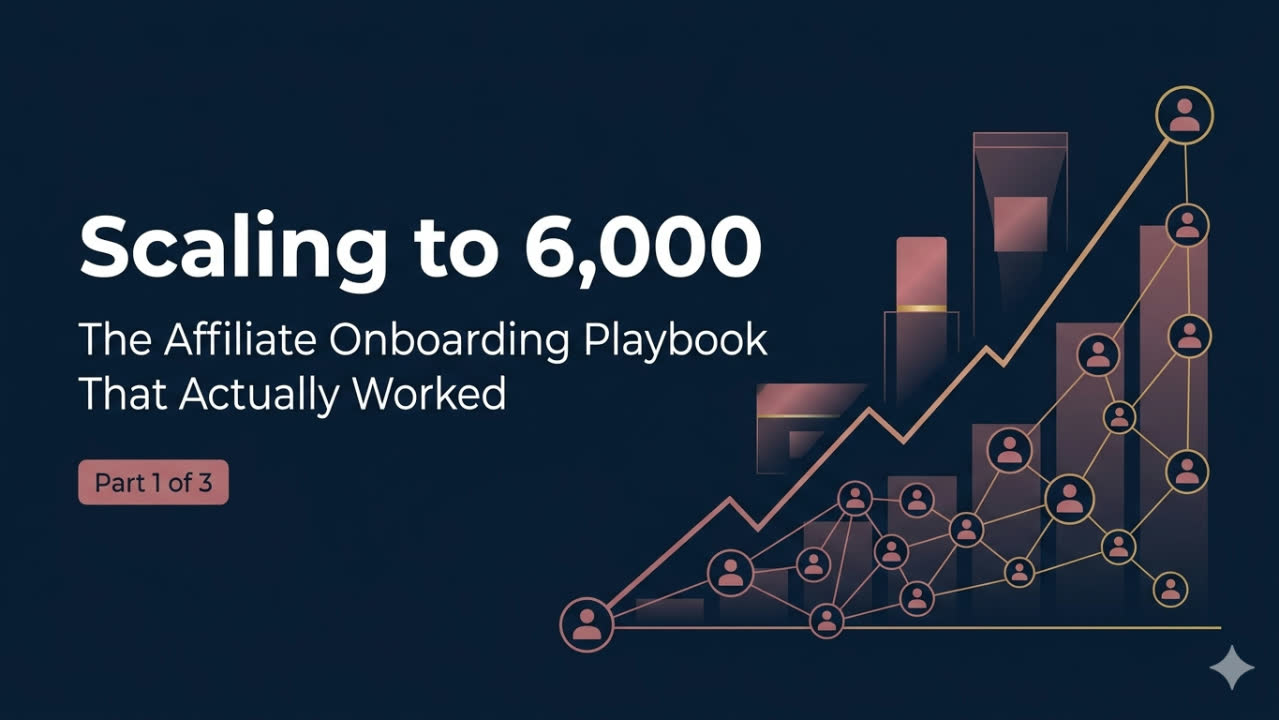
Scaling to 6,000: The Affiliate Onboarding Playbook That Actually Worked
 By Hasbiarahman Efendi · 11 June 2026 · 5 min read
Most affiliate programs don’t have a creator problem. They have a system problem.
When I joined the global account at the mandate was clear: build a creator affiliate ecosystem — fast, at scale, without sacrificing quality.
What followed was one of the most operationally complex quarters of my career.
6,000 creators. 5 people. 90 days.
Here’s the exact playbook we built — and the hard lessons behind it.
The Starting Point: No Playbook Existed
There was no template for this.
Onboarding 6,000 creators in a single quarter isn’t just a recruitment challenge. It’s a logistics, communication, and systems design challenge — all running simultaneously.
With a lean team of 5, every process had to be deliberate. Every tool had to earn its place. And every decision I made as Affiliate Manager had to scale — not just work once.
The first thing I did wasn’t recruiting. It was architecture.
The 3-Layer System We Built
Layer 1: Creator Discovery & Pool Building
We used a third-party platform to source and filter creator pools at volume — filtering by niche relevance, engagement rate, and audience fit for the brand.
The key discipline here: resist the temptation to onboard everyone.
At scale, poor creator fit doesn’t just dilute performance — it creates operational debt. Every off-brand creator you onboard is a support ticket, a compliance risk, and a wasted brief waiting to happen.
We built strict intake criteria upfront, which made everything downstream faster.
Layer 2: Database Management via Spreadsheet
Every creator passed through a centralized spreadsheet database — our single source of truth.
Fields tracked:
• Creator tier and niche category
• Onboarding status (invited → joined → briefed → active)
• Content submission status
• GMV performance tag
Was it glamorous? No. Was it scalable with a team of 5? Absolutely.
The lesson: don’t let perfect tooling be the enemy of operational clarity. A well-structured spreadsheet, owned by a disciplined team, outperforms a poorly implemented CRM every time.
Layer 3: WhatsApp Broadcast for Mass Execution
This is where the real operational complexity lived — and where our biggest crisis hit.
Our initial execution relied on personal WhatsApp numbers for broadcast messaging.
At low volume, it worked. At scale, WhatsApp flagged the activity and banned the accounts.
Full stop. Thousands of pending creator invitations. Pipeline frozen.
The Crisis That Forced a Better System
Getting banned was painful. But it was also the forcing function that made our operation genuinely scalable.
Recommended by LinkedIn
 How to build an affiliate army on TikTok Shop Ashley Wright 2 years ago
 Affiliate Marketer Series: How to Choose the Right… Su Pang 1 year ago
 One email, 10,000 affiliates Noah Prose 2 months ago
We made the call to migrate to a paid WhatsApp Business broadcasting solution — at a cost of IDR 657 per message.
And from that point forward, operations ran without interruption.
whatsapp also unlocked something we hadn’t anticipated: WhatsApp Community infrastructure. Instead of one-way broadcasts, we could now build two-way creator communities — which became the foundation for everything we did in Q2 to grow GMV from 5% to 20%.
But that’s a story for the next article.
What the Numbers Actually Mean
6,000 creators onboarded in one quarter is a metric. Here’s what it represents operationally:
• 6,000 individual outreach touchpoints executed
• 6,000 database records created and maintained
• 6,000 onboarding sequences triggered and tracked
• Hundreds of content briefs distributed and followed up
• A banned account crisis — identified, escalated, and resolved — mid-quarter
All of this with a team of 5.
The real achievement wasn’t the number. It was building a repeatable system that could produce that number.
3 Principles I’d Apply to Any Affiliate Onboarding Operation
1. Design the system before you recruit the first creator.
Onboarding at scale exposes every gap in your process within days. Map your full creator journey — discovery → contact → onboarding → brief → activation — before you start filling the top of the funnel.
2. Your communication infrastructure is your operation.
How you reach creators at 100 is not how you reach them at 6,000. Audit your tools early. The cost of migrating mid-campaign — as we learned — is significantly higher than investing in the right infrastructure upfront.
3. Database discipline is a competitive advantage.
The teams that scale affiliate programs aren’t always the ones with the biggest budgets. They’re the ones with the cleanest data. Know who is in your ecosystem, where they are in the journey, and what they’ve delivered — at all times.
The Bigger Picture
The creator economy is no longer a supplementary marketing channel for beauty brands.
For brands global brand operating in high-competition markets, affiliate creator ecosystems are becoming a primary performance channel — sitting alongside paid media, not beneath it.
But most brands are still treating creator onboarding as a manual, relationship-by-relationship process.
The brands that win in the next 3 years will be the ones that build systems that scale human connection — not ones that try to replace it.
This is Part 1 of a series on scaling affiliate creator ecosystems in Beauty/FMCG. Part 2 covers the community engagement strategy that grew creator GMV contribution from 5% to 20% in a single quarter.
💬 For Affiliate and Partnerships leaders reading this:
What’s the biggest operational bottleneck you’ve hit when trying to scale your creator program — and how did you solve it?
♻️ Repost if you know someone building a creator affiliate program from scratch.
🔔 Follow me for data-driven frameworks on affiliate marketing, creator ecosystems, and social commerce growth.
#AffiliateMarketing #CreatorEconomy #InfluencerMarketing #SocialCommerce #BeautyMarketing #FMCG #GrowthMarketing #TikTokShop #PerformanceMarketing
First published on LinkedIn.